
Anime may be entertainment, first and foremost. But art is almost always political. Anime is no exception.
Many of the most popular and beloved anime have explicit political ideologies. Sometimes they’re expressed overtly. Other times they lurk beneath the surface. In this article, I’ll be exploring some of those anime, from the Marxist to the fascist and everything in between.
“Left” and “Right”: Cross-Cultural Context Matters
Good art doesn’t force an ideology on the viewer. Along those lines, many of the shows I’ll go on to discuss in the article are up for interpretation, and often are understood in ways that are very different from what the author may have intended. For the purpose of this article, I’ll be examining the politics in anime that the original creators explicitly or implicitly intended.

While “left” and “right” refer to similar ideologies in Japan and the U.S., we can’t ignore the culture gap. This can be seen in one of the major themes that most casual viewers pick up from watching anime: namely, pacifism. Pacifism in anime is often seen in a hyper-realistic depiction of the evils of war. This is a far cry from idealized depictions of war that are common in the U.S. This gap may stem from the Japanese experience of defeat in World War II. It means that shows that idealize the military may have a more explicitly right-wing tone to a Japanese viewer than an American one.
Additionally, Japan’s history of imperialism and allyship with Nazi Germany has inspired a lot of anime to depict fascism. This includes characters and countries that are obvious facsimiles for either imperial Japan or Nazi Germany. Representing such a charged history is going to naturally give shows explicit or implicit political themes.
One important trend that I won’t be covering in this article is misogyny and sexualization. A lot of smart people have written about the objectification of women and the sexualization of children that can be commonplace in anime. (And Unseen Japan has tackled some of the objectification controversies surrounding anime and manga characters in Japan before.) While misogyny can be a part of far-right ideologies, it’s too much to unpack in this one article.
One last disclaimer: I’m not a scholar, so this is purely based on my analysis and research from both Japanese and English language sources. Without any further ado, anime from the left and right!
Antifascist Liberalism
A common liberal-to-moderate-left leaning ideology seen in many popular and classic anime is what I’ll call ‘antifascist liberalism.’ These anime tend to have basic liberal values like portraying democracy as good and war as evil. They depict societies ruined by war and power-grabbing. The heroes fight against corrupt existing governments or conspiracies that use violence ruthlessly to achieve their goals. It’s a broad pattern that can be seen in anime ranging from Naruto to Grave of the Fireflies. It’s anti-war, anti-fascist, and pro-democracy.
The hit anime Fullmetal Alchemist: Brotherhood (2009) is a great example.
In the show, two brothers with the power of alchemy uncover the schemes of a corrupt dictatorship that recently engineered a genocide against a minority people and plans to sacrifice its own population. The brothers bring down the government with talent, resilience, and friendship. It ends with the protagonists remodeling but not entirely remaking the existing government, and settling down as a family to live an idyllic, quiet life.
As some bloggers in Japan have pointed out, the emphasis on alchemical equivalent exchange in the show leans left by emphasizing mutual cooperation. Humans need to work in companionship, but can only get as much as they give. It’s an altruistic perspective that promotes equity and opposes exploitation.
There are hints of conservatism in there as well: that individual resourcefulness can change the world, and that a happy ending means a traditional family unit. But overall, ‘antifascist liberal’ themes can be seen clearly in Fullmetal Alchemist and more broadly throughout many Japanese anime.
Leaning Further Left: From Cowboy Bebop to Miyazaki
Many well-known anime build on the basic liberal themes of work like Fullmetal Alchemist and take further left in various directions.
The cult-classic anime of Shinichiro Watanabe—Cowboy Bebop and Samurai Champloo—are perfect examples. Cowboy Bebop extensively depicts how capitalism has ruined Earth and other planets in the solar system by excessive consumption and exploitation, creating a futuristic ‘wild west.” It does this while positively depicting different cultures coexisting in a heterogeneous society.
And Samurai Champloo uses hip-hop and depicts a minority Ryukyuan lead to tell a story about minority culture overcoming the traditional, isolated, and conservative society under the Edo Shogunate.
An example of hardcore left-wing anime that may be surprising to some Americans is Studio Ghibli. Yes, Hayao Miyazaki has a Marxist background and considers himself a leftist, as does Isao Takahata. Miyazaki is on the record of opposing changing Japan’s constitution to beef up the military and saying that Japan should properly compensate Korean women that were forced into prostitution by the Japanese military during World War II. Studio Ghibli even put up a banner opposing nuclear power, a long-running issue for left-wing environmental activists in Japan.
So what about the movies? An emphasis on labor and solidarity among workers can be seen in early films like Nausicaa of the Valley of the Wind and Castle in the Sky. A mistrust of technology lies at the heart of its work: war and weapons ruin the earth in Nausicaa of the Valley of the Wind and Princess Mononoke. Idyllic, peaceful societies have minimal technology, functioning essentially as pre-industrial societies.
One could argue that the best lens to read Miyazaki’s work is a Marxist one. Miyazaki disdains capitalist production in favor of idealized, primal societies. Forests and the wind brings life. Society and productivity bring destruction. Even My Neighbor Totoro depicts a Japan without capitalism, where children get to freely interact with nature.
[Note: Video removed from YouTube]
Anime and the Nationalist Right
With classic anime directors like Hayao Miyazaki and Shinichiro Watanabe leaning left of center, how does the right-wing fit in? Well, let me introduce you to netto uyo: a group of neo-nationalists that emerged in the 2010s and primarily interact online. Their views are characterized by being anti-Korea, anti-China, xenophobic, and Japanese Empire-apologetic. (Read more about contemporary far-right ideas here.)
People with these views started to gather and converse online in the 2000s, according to some commentators, urged on by Japan’s lack of a far-right ultra-nationalist political party. While the Japanese government has made more of a concerted effort to stamp out hate speech against Koreans and other minorities since the mid-2010s, net uyoku ideas have been popping up in popular web novel sites like Shousetsuka ni Narou.
Why does it matter that web novels are being written by the far-right? Well, in Japan, web novels become light novels, light novels become manga, and manga get turned into anime. A highly successful web novel can be the beginning of an anime franchise.
One recent incident along these lines happened with the popular light novel “[New Life+] Young Again in Another World.” It was slated for anime adaptation in Japan and was licensed by J-Novel Club in the U.S. However, the series was canceled because of blatant hate speech against China and Korea by the author MINE. The series portrayed the protagonist taking part in the Second Sino-Japanese War and killing thousands of people.
Japanese commentators have pointed out that this is far from the only nationalist incident in web novels and anime. There are many works on web novel sites based on netto uyo ideas, and currently, the process of commercialization pays no regard to controversial politics until it’s too late. Many web novels simply portray villains as Chinese and Korea. But this can ramp into more controversial stories, like Japanese high schoolers fighting off a group of Koreans who have been summoned from another world.
[Note: Video removed from YouTube]
The Irregular at Magic High School is another example of a popular work that critics pointed out had blatantly anti-Korean elements, although it didn’t receive as much criticism since the anime adaptation ended up cutting some of the corresponding plot points.
The popular series GATE also brushes up against nationalistic right-wing ideals. The show depicts an otaku joining the Japanese Self-Defense Forces (JDSF) to fight a legion of medieval soldiers and monsters, smiting enemies with powerful weapons. As pointed out by critics, the timing of the series’ rise to popularity coincided with the Abe administration’s attempts to pave the way towards constitutional reform. While the original author has claimed that the series is simple entertainment, it clearly fetishizes the Japanese military. And the anime ended up as actual recruitment material by the JDSF.
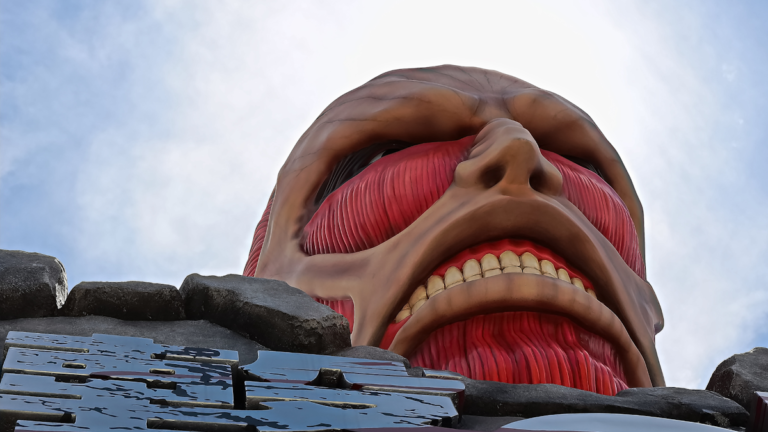
Attack on Titan
Last but not least, the most controversial and popular anime of all that belongs to this discussion: Attack on Titan.
Attack on Titan and its massive fan base has been cited as a driving force in the outstanding global growth of the anime industry. But the dystopian man-eating monster-fighting series contains hints and sometimes more than hints of far-right nationalist politics, which have been widely discussed in Japan since controversy first erupted over the show back in 2013.
Hajime Isayama, the creator of the series, has anti-Korean, nationalist Japanese, anti-Semitic, and pro-Nazi ideas bubbling beneath the surface of his work. Attack on Titan, like GATE, fetishizes the military. It also contains all sorts of uncomfortable references. For example, basing main (and positively portrayed) characters off of Japanese generals that committed large scale atrocities against China and Korea, and including direct references to anti-Semitic conspiracy theories. A Twitter account linked to Isayama praised Japanese imperialism and defended war-criminals.
Isayama has come under fire for these references for years, but when asked how people should view his work, Isayama has always responded along the lines of: “Being a writer, I believe it is impolite to tell your readers how they should your story.” But many on the far-right have caught on to these references, endorsing the anime as describing “the plight of whites” and the “revival of National Socialism.” (For a more detailed analysis of the political subtext of Attack on Titan, check out this essay).
Politics doesn’t take away from art
Attack on Titan is a perfect example of how politics in art can get slippery. Many, and in fact, perhaps most of us, see Attack on Titan as condemning, not promoting, fascism and militarism. It remains a successful work of art because its complex politics can be read in different ways. But that doesn’t change the explicitly political subtext of the work, which has turned both China and Korea against it altogether.
The same goes for Miyazaki films. While it’s safe to assume that most don’t watch Totoro and think, “That’s Marxist,” Miyazaki’s communist ideas and background necessarily come into play.
Japanese artists and storytellers’ attention to war and fascism have created brilliant stories that are difficult to interpret, from Fullmetal Alchemist to Attack on Titan. Some shows are equally political but even harder to interpret, like Code Geass. The protagonist of the show takes control of Japan and uses its people as sacrificial pawns to topple a vicious global dictatorship, freeing Japan along the way.
The richness of political interpretations of these anime is part of why they become so popular and beloved. Nonetheless, explicit political motivations by the works’ creators do matter.
Kind of unfortunate you didn’t mention Eva here since Anno’s origins as a hardcore nationalist leading into becoming a lot more leftwing after his mental breakdown coincide right around the time of the show’s production.
oh my god? i want more info, i never heard about this before!
https://animekritik.wordpress.com/2011/11/22/imperialism-translation-gunbuster-introduction/ this talks a lot about Anno’s history and his origins as a creator, but the short version is as follows:
Anno’s directorial debut was the Gunbuster OVA series which was rife with nationalist imagery and themes about on par with the goofy original plot of Godzilla vs King Ghidorah, some of which he directly stole from a pretty fucked up propaganda film called Battle of Okinawa. Then the bubble burst and Anno had his mental breakdown from stress making Eva which is why the show went insane and became about mental health and the apocalypse. Now he makes Godzilla movies about how a bunch of misfits unwelcome in Japanese society (and also Hayao Miyazaki) come together across borders to peacefully stop a giant monster before America can nuke Japan again after Not Shinzo Abe fails to do anything but make the situation worse.
This is an awesome collection, thank you so much!
I am from former East Germany, and series “Schwarzesmarken”, showing an East German TSF squadron, made me aware of the interesting themes of Japanese anime.
I think many of these comments are valid but shows like Gate wouldn’t get a second look if it was about a nerd joining the US Military. I think correctly that much of this and rightly so is strictly being viewed through a Japanese lens.
Quick correction, I believe you spelled the Attack on Titan’s mangaka’s family name incorrectly, it’s “Isayama” not “Iseyama”.
Also I think it would be helpful to link in the article to one of the blogs ( https://seldomusings.wordpress.com ) that originally accused Isayama of running the @migiteorerno Twitter account and presented their argument for it. Also I think it would be important to mention there has never been any official confirmation that Isayama was connected to the account.
While I personally feel that there isn’t enough evidence to declare that the @migiteorerno Twitter was Isayama’s private account, I can agree the seldomusings WordPress blog wasn’t exactly pulling claims out of thin air, there was some circumstantial evidence that was enough for the blogger (and many others) to be convinced of said accusation. And it’s not like the seldomusings blogger had it out for Isayama or anything, part of why they wrote the blog post was that they were surprised by the possibility that @migiteorerno could be Isayama, because they didn’t think the Attack on Titan series reflected the sentiments of the @migiteorerno account (similar to how many people end up finding out about the Ender’s Game series and Orson Scott Card’s bigoted views).
But even discounting the @migiteorerno controversy, in regard to the Dot Pixis design, while Akiyama Yoshifuru may not have been guilty of crimes on the level of someone like Hideki Tojo, he was still a Japanese Imperial general and thus still complicit with many of the atrocities committed in the name of the Japanese Empire. As such, it’s understandable why many Koreans (and others) would still take offense to such a design choice made by Isayama, plus Isayama’s comment of “I respect for leading such a simple and frugal life” regarding Yoshifuru.
Furthermore, Mikasa was also named after an Imperial Japanese Battleship that served during the Russo-Japan War. While it is true that the practice of naming anime/manga characters after Imperial era vehicles is a not uncommon practice (like Evangelion is chalk full of such examples, e.g., https://tvtropes.org/pmwiki/pmwiki.php/Main/VehicularThemeNaming ) it’s at best still a questionable creative trope in Japanese creatives.
Also Erwin Smith, while significantly inspired by a Watchmen character (and a performer from a Paris Hilton music video), was also almost assuredly (I don’t recall if Isayama ever officially commented on this or not, I only know secondary sources have said Isayama stated such, but I personally have never seen the primary source from Isayama himself) partially based on Erwin Rommel, a German commander from WWII, who is popularly known for being forced to commit suicide (the actual date of which is Erwin Smith’s fictional birthday, October 14th) due to his involvement in a failed plot to assassinate Hitler, but his actual legacy and moral character is, to put it lightly, far more complicated/ethically incriminating. The pop cultural rehabilitation of Rommel is actually a relatively well-known phenomenon in historian/academic circles dubbed the “Rommel myth” (look it up to learn more, plus the Holocaust Museum’s entry on Rommel https://encyclopedia.ushmm.org/content/en/article/erwin-rommel ). While it is relatively likely Isayama is another individual whose main knowledge of Rommel was through said myth, it is still another irresponsible creative choice and gaffe made by Isayama.
And while I personally think that the text of the Attack on Titan series is pretty critical of issues like nationalism, militarism, and racial oppression, etc. The narrative isn’t without its issues, most notably the choice of making there be a “reason” for the Eldians oppression (an unfortunately relatively common trope to other fantasy and sci-fi media, in both anime and superhero works, like the X-Men). Which has been better explained by other critics (e.g. https://twitter.com/weebservations/status/990398895795531776?s=20 )
While such gaffes may be excusable/not a breaking point/not a deciding factor to some, it isn’t unbelievable that it wouldn’t be for others. Like the series itself, the Isayama controversy isn’t a black-and-white issue either, and I personally feel like there isn’t enough evidence to declare Isayama his manga as categorically far-right wing manga, at least intentionally on the creator’s part.
Thanks for the really excellent comment and I have corrected Isayama’s name.
I totally agree with you, but I just come out on a slightly different side – there seems to be enough evidence out there to put AoT in the right-wing category, but acknowledge that it can be interpreted in complex and various ways.