
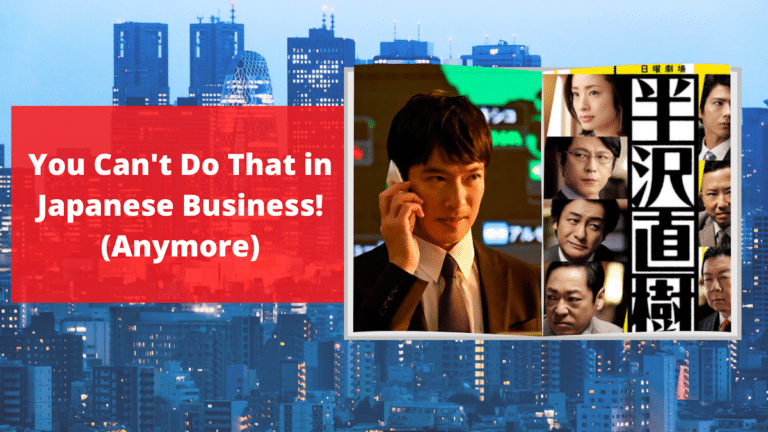
In 2013, Japanese TV station TBS launched a surprise hit. The drama Hanzawa Naoki depicted the title character, a banker, fighting corruption within his own company.
Most Japanese dramas these days are lucky to land double-digit viewership numbers week over week. The better ones can sometimes push around 20% for their final episodes. (Example: The recent adaption of the manga Teseusu no Fune, which nabbed 19.1% for its conclusion.) But the concluding episode of Hanzawa Naoki put those numbers to shame, netting a titanic 42.2%.
So it’s no surprise that TBS would bring the show back seven years later for another go. So far, the station’s been rewarded for its visit to the vault. Its first episode grabbed a 22% viewership – and, while most dramas lost percentage points week over week, Hanzawa Naoki Season 2 is defying the odds: its recent 3rd episode grew its audience share to 23.2%.
But while Hanzawa Naoki is wildly popular, even the people who love it (your author included) can’t help but ignore the ways in which it feels, not just dated, but in some cases, downright unrealistic.
NOTE: Potential spoilers for Hanzawa Naoki 2 follow.
Doing The Right Thing (At a Price)
Hanzawa Naoki is the creation of novelist Ikeido Jun (池井戸潤). A former employee of Mitsubishi Bank, Ikeido quit in 1995 and worked as an independent consultant while also polishing his writing.
Since his debut in 1998, Ikeido has created several memorable book series based on his business world experience, each of which has received a popular dramatic treatment. His Shitamachi Rocket series (下町ロケット) follows the head of a small space engineering firm and his fight to keep his father’s company afloat while pushing advances in rocket design. And his Hanasaki Mai series centers on a former teller who, along with her boss, resolves issues and scandals that crop up at the branches of their employer, Tokyo 1st Bank.
There are a couple of consistent themes in Ikeido’s work. One is that he largely sticks to the adage “write what you know”. In Ikeido’s case, that’s the world of business – particularly, the world of high finance.
Another is that Ikeido loves to tell the tale of business heroes – people who oppose corruption and who stand up for what’s right, even when doing so comes at great personal expense. Series 1 of Hanzawa Naoki ended with Hanzawa banished from his main employer, Tokyo Central Bank, to a subsidiary, Tokyo Central Securities. Throughout the first half of season 2 of the series, Hanzawa faces the prospect of further banishment – this time, from Tokyo and into the sticks of Japan. (I’ve written before about this theme in Ikeido’s works in another Patron-only piece on the dramas Aibou and Doctor X.)
It’s not hard to see why Ikeido’s stories are popular. In an explicitly hierarchical society where power is often exercised arbitrarily, Ikeido writes stories of rebellion – tales of valor where the heroes are low-level sarariimen and sarariiuumen doing their jobs, no matter the obstacles thrown in their way.
A Bygone Era?
Yet despite its popularity, viewers can’t help but notice that the latest series feels “very Showa era” in its construction. The offices of both Tokyo Central Bank and Tokyo Central Securities are highly male-dominated. There are few female characters in the show; those that do exist have little direct impact on the plot. Hanzawa’s spouse, Hana, is a housewife – an increasingly rare phenomenon in a country that’s seen a steady rise in dual-income households in the past few decades.
Now, I’ll admit we’re on somewhat iffy ground here. Hanzawa Naoki is, after all, a work of fiction. It has no obligation to depict the world as it actually is in 2020. And the show proves by its cast alone – chock full as it is with scenery-chewing luminaries of Japanese stage and screen such as Sakai Masato as the title character and Kagawa Teruyuki as his rival Owada Akira – that the show doesn’t take itself that seriously. Over-the-top theatricality is on full display here.
All that said, it’s interesting to hear about the ways in which the series leaves younger workers in Japan thinking, “Yeah, that’d never happen”. The magazine BizSPA tackled just that topic recently, asking people in their 20s what aspects of the new series they found off-putting.
“I Don’t Want to Hear My Boss Talking to His Wife”
At the top of BizSPA’s list is a scene in which, while out drinking with co-workers, Hanzawa talks with his wife, Hana, in front of his subordinates. The scene is meant to be touching – a way of showing that Hanzawa the Financial Bulldog has a softer, gentler side outside of the office. But those interviewed for the article found the scene hard to watch. One 23yo man said: “The call is fine, but I’d want him to talk so that I didn’t have to hear it. I don’t really wanna know what my boss is like at home.”
“You Can’t Grab Your Subordinates By The Balls!”
A more serious manner is the way the series depicts power harassment – including casual violence and sexual harassment – by superiors against their juniors. In one notable scene in Episode 3, an employee who backtalks his boss quickly regrets his decision when his kintama take the L for his insubordination:
In a less extreme example discussed in BizSPA’s article, a character in Episode 2, Miki, is called back from Tokyo Central Securities to the mothership, where his new superior, Morota, forces him to make copies while hitting him and berating his performance.
Sadly, such examples of power harassment are not extinct in Japan. But they’re becoming more and more rare. And fewer younger workers are willing to suffer such abuse the same way their parents did. As one respondent told BizSPA, “If that were happening to me, I wouldn’t show up for work.”
“Friends Don’t Let Friends Share Inside Info”
The main battle in the first part of Hanzawa 2 concerns the buyout of a technology firm named Spiral – a project that Japan Central Bank’s Isayama yanked out from under the nose of Hanzawa’s team at Japan Central Securities. Convinced something nefarious (and possibly illegal) is afoot, Hanzawa relies on his friend Tomari Shinobu, who still serves at Tokyo Central Bank, to give him the inside scoop.
Commenters expressed a whole lotta iwakan over that move. “Tomari’s ability to get information is amazing. But saying he can’t refuse helping…that makes him a spy.”
“…Or Leak Secrets”
The corporate espionage goes even further in the series, though, when Miki, Hanzawa’s former co-worker, steals a hard copy of the Spiral buy-out plan and leaks it to Hanzawa. BizSPA notes that we’re probably willing to overlook this since Hanzawa’s enemies are so despicable, “but it’s not something workers should emulate.”
“You’re In My Personal Space Bubble”
I found the fifth and final observation really interesting. It wasn’t even something I explicitly noticed until I read the BizSPA article. But in the world of Hanzawa Naoki, everyone is constantly up in everyone else’s face.
BizSPA’s example: This scene in Episode 1 where Hanzawa confronts Isayama with a mail proving his duplicity in the Spiral deal. However, Isayama and his cohorts have had the mail wiped off of the company’s servers. (Which, frankly, as an IT professional, I find to be yet another highly improbable scene. A company where senior executives can easily delete incriminating emails is a Compliance nightmare and a series of bankrupting lawsuits waiting to happen. But anyhow.)
Isayama rips up the email in front of Hanzawa. But he’s not done, folks! After ripping it up, he pets Hanzawa’s face with it.
This certainly has all the flavor of a bygone era of alpha-male dominance. Says one 29-year-old office employee: “In an era of social distancing, having some middlee-aged dude get up in your face is too much.”
As I said at the top of the article, Hanzawa Naoki is, in the end, a work of fiction. It doesn’t need anyone’s permission to take dramatic license. But it’s important while watching it to understand that it doesn’t necessarily represent the Japanese business world of 2020. While there are many ways that business culture in Japan could still improve, things have come a long way from the days when author Ikeido Jun first cut his teeth in the banking industry.


I see the “over the top kabuki theatrics” to be a systemic issue in Japanese television– you’ll see it in anime, you’ll see it in other dramas, as though a character can’t seem to drive a point home without screaming it at the top of his lungs complete with the “brogue” of a jazz vocal virtuoso. If someone did it in real life, even in Japan, people would look for hidden cameras thinking it’s a stupid low budget reality show, or they’d call the cops suspecting the guy’s on drugs. The “LOOKIT ME I’M A VILLAIN (or crappy sidekick)” characters like Kagawa in Hanzawa, and many other dramas and anime, are frequently from kabuki families, and the punch line to that is, they’re actually toning their performances way down. This isn’t the only comically nonsensical and Japanese trope in dramas, of course. There’s the good old “daimyo gyoretsu” (bigshot doctor/businessman/politician and his entourage of yes-men) and the obnoxiously screaming second-in-command who cares more about his Godfather boss’ image and the absolute obedience/loyalty of the hero than his own dignity.
Speaking of anachronistic, the show’s idea of deleting files from a server is to run an arcane deletion command one file at a time, when deleting folders, deleting lists of files, honeypots that fool newly-unauthorized users all are in regular use, unless Japan’s datacenters are over 30 years out of date (which wouldn’t surprise me), and the show’s idea of deleting email is to tell the IT staff to just nuke the emails (as though the datacenter doesn’t have backups– Hanzawa could have left the scene, hopped into a random phone booth, called up the Ministry of Finance, and left an anonymous tip that there’s some incriminating emails in the datacenter’s backup tapes; he could have thrown in the hard copy of the email in question to trigger a stereotypically Japanese enforcement party comprising of 150 agents). Both acts of data deletion are very illegal (obstruction of justice, destruction of evidence), and demonstrate that whoever wrote those scenes has no idea how computers and digital data work.
I would have had run the first scene like this: Minister Drag Queen demands access to the confidential server. Hanzawa agrees, stalling for time while a subordinate texts the Spiral CEO. After a few minutes of Drag Queen whining impatiently, Hanzawa produces the login credentials, offering to make a computer available, (which Drag Queen naturally refuses at the top of his lungs). Drag Queen then eagerly and very unethically breaks into the server, only to find that the account is locked for too many wrong password attempts and can’t access anything. Hanzawa insincerely apologizes, saying, “He’s got a bad habit of misremembering his passwords, and they’ve been working on restoring his account for a week now. They haven’t found the cause yet.” Cut to the control room where the engineer has a good laugh watching Drag Queen go nuts, saying, “Too easy.” Throw in an explanation sequence if necessary. Plenty of drama/comedy, no unethical destruction of data right in front of a government official, no technobabble BS.
The second one could have been a similar service to SnapChat. No point in a paper copy of an alleged screenshot when the original data is no longer there.
Oh yes, that ENTIRE data scene is just ridiculous. Not as bad as the episode of BONES where a criminal mastermind supposedly infected their servers with a virus by putting QR codes on bones, but…pretty cringe. I’ve honestly given up on TV ever getting tech right.